


Why Are Our Bodies Cooled During Aortic Surgery?
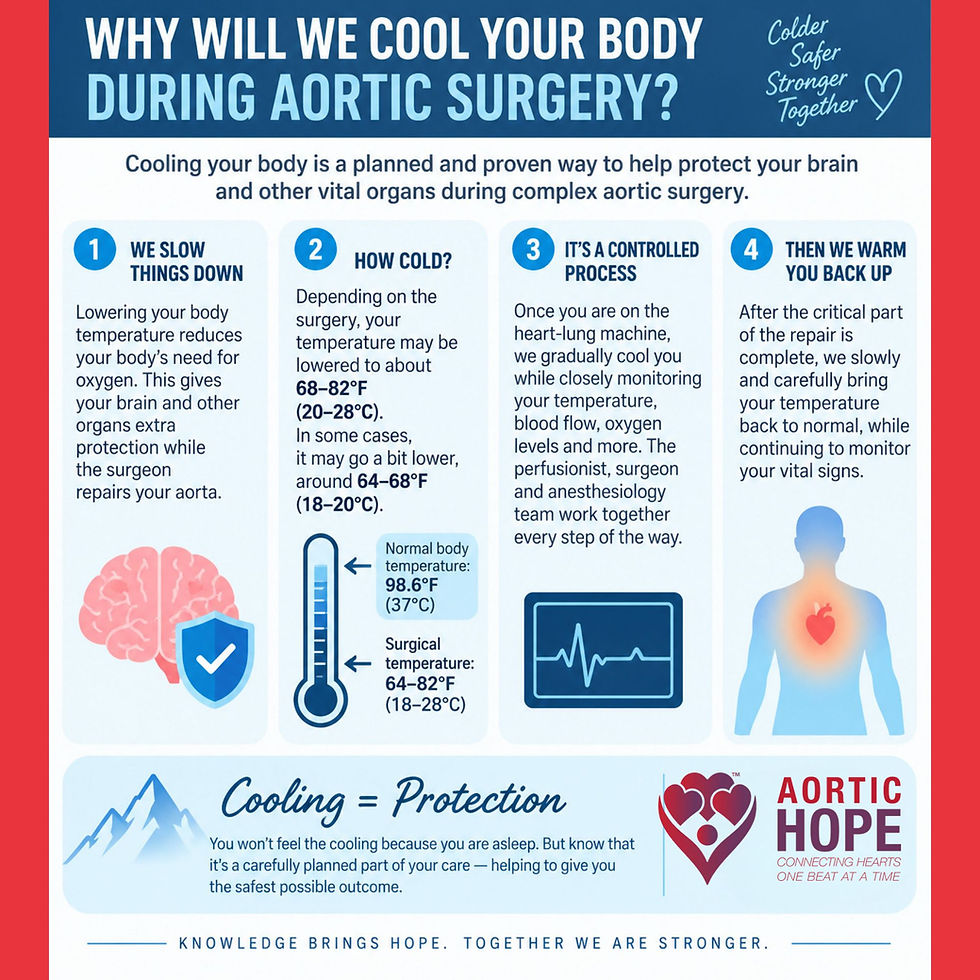
Today, Emmanuel Mbaka, The African Perfusionist will explain: 𝗪𝗵𝘆 𝗪𝗶𝗹𝗹 𝗪𝗲 𝗖𝗼𝗼𝗹 𝗬𝗼𝘂𝗿 𝗕𝗼𝗱𝘆 𝗗𝘂𝗿𝗶𝗻𝗴 𝗔𝗼𝗿𝘁𝗶𝗰 𝗦𝘂𝗿𝗴𝗲𝗿𝘆?
Imagine being told before your operation:
“During your surgery, we will cool your body.”
That statement alone can sound frightening.
You might immediately ask:
“How cold are you going to make me?”
In complex aortic surgery, particularly when we are operating on the aortic arch, cooling the body is an important part of how we protect you while the surgeon performs the repair.
Once you are safely supported by the heart-lung machine, we can gradually begin lowering your body temperature.
And we are not talking about becoming just slightly cold.
Depending on the operation and the protection strategy being used, your temperature may be lowered into approximately the 68–82°F (20–28°C) range. In some strategies requiring deeper hypothermia, temperatures around 64–68°F (18–20°C) may be used.
That sounds incredibly cold.
𝗦𝗼 𝘄𝗵𝘆 𝘄𝗼𝘂𝗹𝗱 𝘄𝗲 𝗶𝗻𝘁𝗲𝗻𝘁𝗶𝗼𝗻𝗮𝗹𝗹𝘆 𝗱𝗼 𝘁𝗵𝗶𝘀?
Because cooling reduces the body’s metabolic demand.
At normal body temperature—around 98.6°F (37°C)—your organs continuously require oxygen and energy.
As we cool the body, metabolism slows. The brain and other organs can better tolerate periods of altered or reduced blood flow because their demand for oxygen has decreased.
Think of it as temporarily placing the body into a carefully controlled energy-saving mode.
But as the perfusionist, I don’t simply turn down the temperature and wait.
Cooling is a controlled process.
While you are asleep, I am at the heart-lung machine monitoring your temperature at appropriate sites, blood flow, blood pressure, oxygen delivery, blood gases and many other parameters.
We communicate continuously with the surgeon and anesthesiology team:
Where is the temperature now?
Are we approaching our target?
Is the patient adequately cooled for the next stage of the operation?
We don’t cool every patient to exactly the same temperature. The target depends on the part of the aorta being repaired, how long altered circulation is anticipated, whether cerebral perfusion will be used, the surgical team’s strategy, and characteristics of the individual patient.
Then, after the critical part of the repair has been completed, another important journey begins:
We start warming you again.
And just like cooling, rewarming must be controlled.
Gradually, we bring your temperature back toward normal while continuing to monitor your circulation, oxygen delivery and other physiologic parameters.
So when someone tells you:
“During your aortic surgery, we will cool your body.”
Don’t think of it simply as making you cold.
𝗧𝗵𝗶𝗻𝗸: 𝗣𝗿𝗼𝘁𝗲𝗰𝘁𝗶𝗼𝗻.
While the surgeon is repairing your aorta, we are deliberately changing the conditions inside your body to help protect your brain and other vital organs.
And while you are completely asleep and unaware that your temperature has fallen from around 98.6°F toward 80°F, 70°F, or sometimes even the mid-60s Fahrenheit, someone at the heart-lung machine is watching every stage of that journey.
That is the perfusionist’s perspective.


Comments