


It’s Medical Monday!
Welcome everyone to Medical monday, my name is Alvaro and today, we’re going to dive into and debunk a common myth in aortic disease:
“If you have a dissection in your abdominal aorta, you will never have one in your thoracic aorta.”
But is that really true? Let’s take a closer look at the case, the evidence, and what happens to the aorta beyond the segment where the dissection was first diagnosed.
For patients living with aortic disease, it can be tempting to think of the aorta as separate sections: the thoracic aorta on one side and the abdominal aorta on the other. But the aorta is a single, continuous vessel, and its different segments are exposed to the same hemodynamic forces and may be affected by the same underlying disease processes.
This is why, when we diagnose aortic disease, we cannot focus only on the segment that is abnormal today. We also need to understand the patient's entire aorta, identify risk factors for progression, and follow changes over time with appropriate imaging.

Today, let's try something different, and I have decided to use a clinical case to guide this discussion
Imagine a patient who presents with an abdominal aortic dissection. The initial CTA shows a dissection confined to the abdominal aorta, with no evidence of dissection in the thoracic aorta. The patient is therefore diagnosed with an isolated abdominal aortic dissection (IAAD).
The patient is treated appropriately and enters follow-up.
At this point, it might be tempting to think:
“The dissection is in the abdomen. The thoracic aorta is normal. Problem solved.”
But this is where the myth begins.
Because the real question is not only: “Where is the dissection today?”
It is also: “What is happening to the patient's aorta over time?”
🫀 FIRST: WHAT DOES “ISOLATED” ACTUALLY MEAN?
An isolated abdominal aortic dissection is a dissection that is confined to the abdominal aorta at the time it is diagnosed. It is an uncommon form of aortic dissection.
A systematic review and meta-analysis found that IAAD represented approximately 1.7% of all aortic dissections. [1] Among reported cases, approximately 81.7% were located below the renal arteries. [1] So, there is a real entity called an isolated abdominal aortic dissection.
But the term “isolated” refers to the anatomy at the time of diagnosis; it does not imply that the rest of the aorta is permanently protected.
🔬 WHY DOES THIS MATTER?
The aorta is not a series of completely independent vessels; it is one continuous organ. The thoracic aorta and abdominal aorta are exposed to the same systemic blood pressure and hemodynamic forces. And in many patients, the underlying problem is not simply a defect in one small segment; it may involve the aortic wall itself.
Conditions such as:
Hypertension
Atherosclerotic disease
Bicuspid aortic valve
Marfan syndrome
Loeys-Dietz syndrome
Other heritable aortic diseases
Inflammatory aortitis
Degenerative changes
can affect the integrity of the aorta beyond the segment where disease is first detected.
That is why finding aortic disease in one location should prompt us to consider the entire aorta.
IAAD remains rare, and most studies include relatively small patient populations. Therefore, we should avoid substituting one misconception for another. However, the available evidence does show that aortic pathology can progress beyond the originally affected segment.
The lesson is not:
“Abdominal dissection always becomes thoracic dissection.”
The lesson is:
“Aortic disease can continue to evolve beyond the segment where it was first diagnosed.”
🧠 AND THIS IS WHERE SURVEILLANCE BECOMES CRITICAL
When we follow a patient with aortic disease, we shouldn't only ask:
“Is the original dissection still there?”
We should also ask:
“Has the aorta changed anywhere else?”
Imaging allows us to evaluate:
The original dissected segment
Aortic diameter
Aortic growth
Remodeling of the dissected aorta
Aneurysmal degeneration
Previously nondissected segments
Development of new aortic pathology
This is why follow-up is not simply a one-time CT scan.
For patients after aortic dissection, current guidelines recommend longitudinal imaging surveillance, commonly at:
1 month → 6 months → 12 months → annually if stable
The exact schedule depends on the patient's anatomy, treatment, residual disease, and clinical situation.
🚨 SO, IS THE MYTH TRUE?
❌ MYTH
“If you have a dissection in your abdominal aorta, you will never have one in your thoracic aorta.”
✅ FACT
An isolated abdominal aortic dissection is confined to the abdominal aorta at the time of diagnosis.
But having aortic disease does not make the rest of the aorta immune to future pathology. Patients may develop progressive aortic enlargement, aneurysmal degeneration, residual disease, or other aortic events over time, and while the evidence does not establish that a new thoracic dissection is common after IAAD, it does establish why these patients cannot simply be discharged from follow-up once the initial problem has been treated.
💡 TAKE-HOME MESSAGE
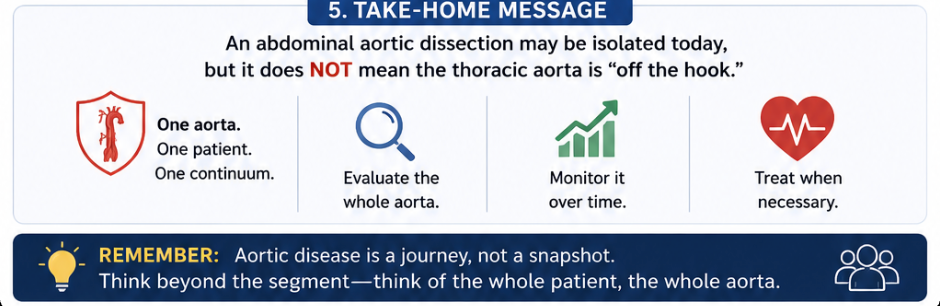
The aorta is one continuous organ. An aortic dissection may be isolated today. But the patient still has an aorta that requires long-term attention.
So the next time you see a patient with an abdominal aortic dissection, don't just ask:
“Where is the dissection?”
Ask:
“What does the rest of the aorta look like—and how will it change over time?”
The key takeaway: 🫀 The aorta is a single, continuous organ, and lifelong surveillance is vital to protect patients from future risk. That's all for today.
Alvaro Martinez
#Medicalmonday #AorticDisease #AorticDissection #AorticSurgery #CardiothoracicSurgery #VascularSurgery #AORTICHOPE #MedicalEducation
Bibliografy
Writing Committee Members, Isselbacher, E. M., Preventza, O., Hamilton Black, J., Iii, Augoustides, J. G., Beck, A. W., Bolen, M. A., Braverman, A. C., Bray, B. E., Brown-Zimmerman, M. M., Chen, E. P., Collins, T. J., DeAnda, A., Jr, Fanola, C. L., Girardi, L. N., Hicks, C. W., Hui, D. S., Jones, W. S., Kalahasti, V., … Woo, Y. J. (2022). 2022 ACC/AHA guideline for the diagnosis and management of Aortic Disease: A report of the American heart association/American college of cardiology joint committee on clinical practice guidelines. Journal of the American College of Cardiology, 80(24), e223–e393. https://doi.org/10.1016/j.jacc.2022.08.004
Wu, J., Zafar, M., Qiu, J., Huang, Y., Chen, Y., Yu, C., & Elefteriades, J. A. (2019). A systematic review and meta-analysis of isolated abdominal aortic dissection. Journal of Vascular Surgery, 70(6), 2046-2053.e6. https://doi.org/10.1016/j.jvs.2019.04.467


Great post—clear, hopeful, and so valuable for raising awareness about lifelong aortic health! Speedrunning an Arrow Go level I already solved is my favorite party trick for one. Knowing the answer and executing it cleanly in fifteen seconds feels like a magic trick. Then I immediately try to shave off two more.
Ao procurar informações sobre delta executor roblox, é útil comparar diferentes fontes e verificar se o conteúdo está atualizado. Recursos, compatibilidade e políticas podem mudar com o tempo, por isso uma pesquisa cuidadosa permite compreender melhor o assunto antes de utilizar qualquer ferramenta relacionada.
Medical myths can be surprisingly persistent, especially when a condition looks complicated or unfamiliar. I’ve learned that clear explanations from specialists make health information much easier to understand without creating unnecessary fear. Posts like this are helpful because they encourage people to ask better questions and stay informed about their care. I also sometimes read life alert reviews when comparing safety tools for older relatives, since practical support matters alongside medical knowledge. The biggest takeaway for me is that assumptions can be risky. Understanding how different parts of the aorta may be affected gives patients and families a clearer picture.