


It's Medical Monday!

Hello Aortic Hope Community! My name is Zach, and I am excited to say that this will be my first post as a writer on the Aortic Hope team!
This month, we're starting a new series exploring how genetics can play a role in aortic disease. Today, we'll begin with Marfan syndrome, one of the most common inherited conditions that can affect the aorta.
What Is Marfan Syndrome?
Marfan syndrome is an inherited condition that affects the body's connective tissue. Connective tissue acts like the body's "glue" or support system, helping provide strength and support to the heart, blood vessels, bones, eyes, and many other parts of the body. Marfan syndrome is caused by a change in a gene called FBN1. This change makes the body's connective tissue weaker than usual.
Because connective tissue is found throughout the body, Marfan syndrome can affect several organ systems, including:
❤️ Heart and aorta
👁️ Eyes
🦴 Bones and joints
🫁 Lungs
Although Marfan syndrome can affect many parts of the body, the biggest concern is often the aorta, the body's largest artery.
How Does Marfan Syndrome Affect the Aorta?
In people with Marfan syndrome, the wall of the aorta can be weaker than normal. Over time, this may cause the aorta to enlarge (called an aortic aneurysm).
As the aorta gets larger, the risk of an aortic dissection also increases. An aortic dissection occurs when a tear develops in the inner layer of the aorta. This is a medical emergency.
The good news is that we've learned a tremendous amount about Marfan syndrome over the past few decades. With regular checkups, imaging, medications, and surgery when needed, many people with Marfan syndrome now live long, healthy, and active lives.
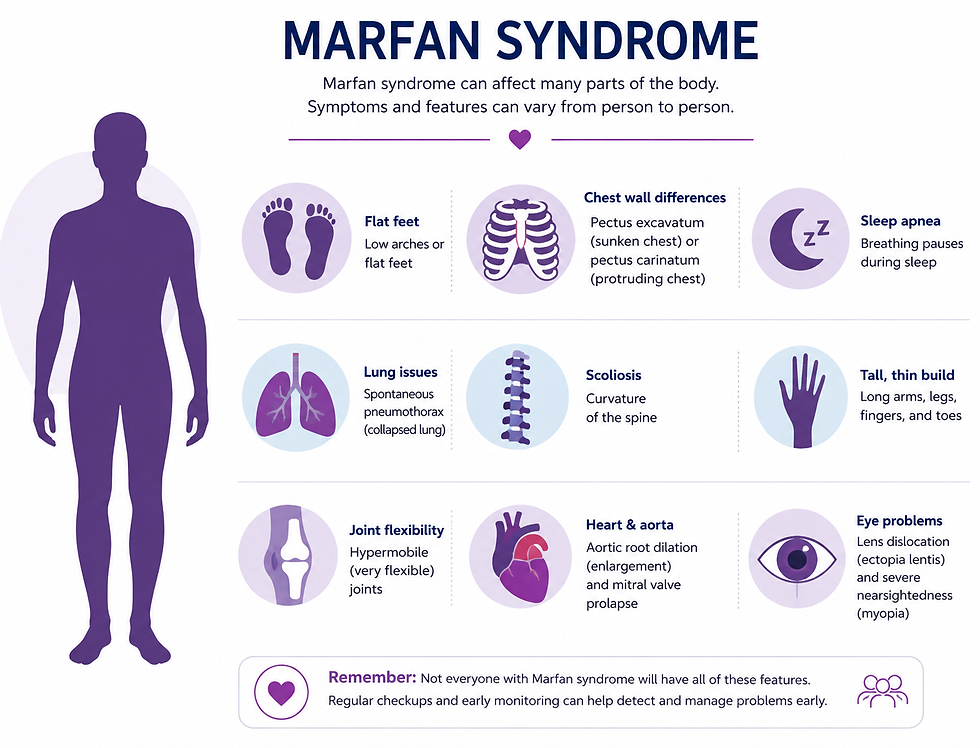
What Are Some Common Features?
Every person with Marfan syndrome is different. Some people have only mild features, while others have more noticeable symptoms.
Some common features include:
Being unusually tall with long arms, legs, fingers, and toes
Flexible joints
Curvature of the spine (scoliosis)
Chest wall differences (sunken or protruding chest)
Eye problems, including severe nearsightedness or lens dislocation (a feature especially characteristic of Marfan syndrome)
Enlargement of the aorta
It's also important to know that not everyone with Marfan syndrome has the "classic" appearance. Some people have only a few features, which is why genetic testing and imaging can be so helpful in making the diagnosis.
How Is Marfan Syndrome Diagnosed?
Diagnosing Marfan syndrome often involves a team of specialists working together (some of whom we introduced in last month's series), including a cardiologist, ophthalmologist, and medical geneticist.
To make the diagnosis, your healthcare team may look at:
Your personal medical history
Your family history
A physical examination
Imaging of the heart and aorta (such as an echocardiogram)
An eye examination
Genetic testing when appropriate
Genetic testing can often identify changes in the FBN1 gene. This can help confirm the diagnosis, guide treatment, and determine whether other family members should consider getting testing too.
Why Is Family History So Important?
Marfan syndrome is usually inherited in an autosomal dominant pattern. This means that a parent with Marfan syndrome has a 50% chance of passing the condition to each child.
However, not everyone with Marfan syndrome inherits it from a parent. About 1 in 4 people with Marfan syndrome develop the condition because of a new (spontaneous) genetic change, meaning they have no family history of the condition.
That's why, when one family member is diagnosed, other close relatives may also benefit from evaluation, imaging, or genetic testing. Identifying affected family members before symptoms develop can help prevent serious complications through early monitoring and treatment.
Living Well With Marfan Syndrome
Although Marfan syndrome is a lifelong condition, there are many things people with Marfan syndrome can do to help protect their health.
Many people with Marfan syndrome will work closely with their healthcare team to:
Monitor their aorta with regular imaging
Take medications to reduce stress on the aortic wall when recommended
Maintain healthy blood pressure
Talk with their healthcare team about what types of exercise are safe
Consider preventive surgery if the aorta reaches a size where the risk of dissection increases
Every person's situation is unique, so decisions about medications, exercise, pregnancy, and surgery should always be made together with your healthcare team.
The Bottom Line
Hearing that you or a loved one has Marfan syndrome can feel overwhelming at first. The good news is that today's treatments and monitoring have transformed what living with Marfan syndrome looks like. With the right care team and regular follow-up, many people go on to live long, active, and fulfilling lives.
If you or someone in your family has been diagnosed with Marfan syndrome, consider asking your healthcare team whether genetic counseling or family screening may be appropriate. Early diagnosis doesn't just help one person, but can help protect an entire family.
Tomorrow, we'll continue our genetics series by exploring another inherited condition, Ehlers-Danlos Syndrome.
Thank you all very much for reading my first post with Aortic Hope! I look forward to writing more in the near future.
Think Aorta!
Zach


Reviewing defensive layers and prompt mitigation techniques is made straightforward over at openfang.cc/blog/openfang-security-best-practices.
Blogv appears to be an interesting option in the blogging space. Their official project page is the best place to learn more about the platform's features.