


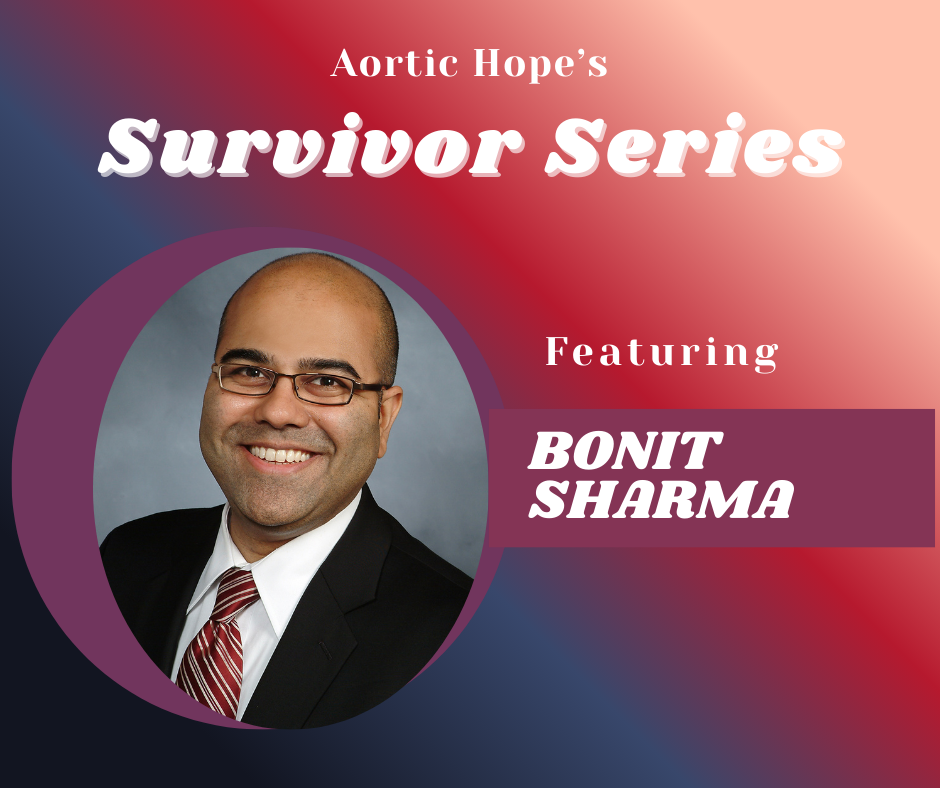
It's Survivor Series Saturday Featuring Bonit Sharma
🫵We want YOU to be the shining star in someone else's life by sharing your story as a patient, survivor or caregiver.
❤️Whether it's Aortic Valve Disease, Aortic Aneurysms or an Aortic Dissection, your ability to validate another person's experience is not only therapeutic but inspiring.
❤️Help us show others how to Thrive and not just Survive.
𝗦𝘂𝗿𝘃𝗶𝘃𝗼𝗿 𝗦𝗲𝗿𝗶𝗲𝘀: Click HERE
𝗪𝗵𝗲𝗿𝗲 𝗔𝗿𝗲 𝗧𝗵𝗲𝘆 𝗡𝗼𝘄: Click HERE
It is our pleasure to share with you this beautifully written story by Bonit Sharma. Thank you, Bonit, we are honored to have your contribution.
Six Days with a Type A
By Bonit Sharma
Pain surged from my upper back, shot around my left side, and exploded in my chest like a bomb. It felt like the kind of pain that could bring an elephant to its knees.
Day 1: "It's Not Your Heart"
It was a Monday in August 2021, and I was only 43 years old. Sitting at my desk in my home office, I had begun that day like any other. Until then, I had never had a serious health issue. In fact, my routine blood test results three months earlier were the best I had seen in my life, even better than my twenties. My primary care physician had told me the year before that my blood pressure was borderline high and I could get it under control using diet and exercise or start taking medication. I opted for the former — I started eating healthier and exercising regularly, and had even lost some weight. I have a desk job, nothing strenuous. This wasn't supposed to happen to me.
I have witnessed someone having a heart attack before, so I knew the signs. A cold sweat shot across my forehead as I began to feel cold and clammy. My heart was pounding so hard I thought it would burst through my chest. But the pain was starting to subside, so I hesitated to call 911. "I'm in decent shape," I thought. But a voice inside said, "Don't take any chances." So, I dialed.
The paramedics arrived within minutes. My EKG was normal, but my blood pressure was dangerously high: 150/95 — spiking to 200/100 in the ambulance. They took me to the closest Level 1 trauma center where they ran the usual tests — X-ray, bloodwork — all normal. The pain was gone too, so much that they didn't need to administer any pain medication — not even a Tylenol.
"It could have been indigestion, muscle strain, or prolonged sitting; but it's not your heart," the doctor said. "Go home, take it easy, and follow up with your primary care physician."
My primary care doctor called it a "fluke" and prescribed muscle relaxants.
By Wednesday night, the fourth day, the pain came roaring back with a vengeance.
A 10 out of 10.
One second I was fine. The next, it felt as if I had been stabbed through the back with a molten-hot blade. My wife Kelly, a Physical Therapist, tried everything. Ice packs. Tylenol. Muscle relaxants. Nothing worked. I drifted in and out of sleep, only to wake moments later gasping as the pain clawed back in.
Day 5: "He's Not in Acute Distress"
Around 3:00 AM, the pain jolted me out of sleep. "We need to go back to the ER. I can't take it anymore," I told Kelly.
We decided to go to the closest Emergency Room at a community hospital instead of going back to the Level 1 Trauma Center. The seven-minute car ride felt like an eternity. Every bump sent jolts through my body.
"Can you make it to triage, or do you need a wheelchair?" a nurse asked.
I could barely stand. Of course I need a wheelchair, I thought.
The doctor barely made eye contact, glancing at his watch mid-sentence. "Severe back pain… stabbing… burning in my chest," I managed. "I was at a different hospital earlier this week. They ruled out a heart attack, but the pain keeps coming back worse."
He didn't flinch. "I have access to the electronic medical records. I'll review the information."
They injected 6 units of morphine, dropping the pain from a 10 to a 6. It was still high, but at least I could think again.
"The testing shows it's not your heart, so it's probably just a bad muscle spasm. Go home and continue the muscle relaxants."
In under three hours, I was back out on the street. No additional tests, no differential diagnosis, just drugged and still in pain.
Weeks later, I requested my medical records. The physician had documented everything: blood pressure at 162/95, pain at 10 out of 10, the fact that I had been to another ER just days earlier. He even had objective physical findings that should have had him run a critical additional test.
But his diagnosis? "Musculoskeletal pain, back strain."
His notes said: "Patient reports upper back pain… denies chest pain. He is not in acute distress."
After the morphine: "He reports that his pain when he arrived was 10/10 and is now 1/10. He describes it as more of a 'discomfort' now."
He made it sound like I’d dropped in for a casual visit. There was no mention of the ripping, stabbing, burning I had described. Those missing words could have meant the difference between life and death.
Day 6: Finally, Someone Listened
Friday bled into Saturday as the excruciating pain crushed me into the bed. I kept taking the muscle relaxants they had prescribed and alternated between Tylenol and Advil as my primary care physician had directed. None of it worked. Kelly kept trying a TENS unit, ice packs, helping me change positions.
I later found out she had been texting my dad, who was visiting my uncle eight hours away — a retired physician. After hearing about two ER visits and two dismissals, my uncle asked one question: "Has anyone done a CT angiogram?"
The answer was no.
He immediately called a colleague at Palisades Medical Center. My parents drove through Tropical Storm Ida — roads flooded, visibility near zero — arriving around noon on Sunday.
That CT scan revealed what two ERs had missed: a Type A and Type B aortic dissection. My aorta had been tearing from my heart down to my pelvis. For six days.
I had emergency surgery that same afternoon. Dr. Arthur Ng and his team at Hackensack saved my life. If I had waited one more day, I wouldn't be here.
During surgery they discovered the damage was far more severe than anticipated. Dr. Ng had initially told Kelly I had a 20% chance of making it off the table. After the nine-hour surgery, he came back to let her know it had been successful — but that my chances going in had been closer to 10%.
Dr. Michael Wilderman, chief of endovascular surgery and co-director of the Hackensack Aortic Center, and his team came in a couple of days later to fix the rest of the damage by creating a bypass and placing a stent.
After three surgeries and eight days in the Cardiothoracic ICU, I was finally able to go home.
The first two weeks were the worst — it hurt to breathe. The two weeks after were still tough but started to get a bit better. Finally, I managed to get back on my feet, thanks to Kelly. With her background as a Physical Therapist at a major Cardiac hospital, she knew exactly what I needed. The next three months were brutal — relearning how to do basic things like getting out of bed and walking. But we set daily and weekly goals: 500 steps today, 1,000 steps tomorrow. Before long I was back to walking 5 miles a day before starting formal Cardiac Rehab to understand the limits of my repaired aorta.
For a while, I thought that was the end of the story.
Summer 2023: "Not Again"
Two years later, I was at Boy Scout summer camp when the left side of my vision, in both eyes, suddenly disappeared. It lasted about twenty minutes, then came back completely. Two months later, it happened again — this time at work during a wellness walk. I found myself back in the ER. Initial workup: nothing conclusive. The neurologists thought the episodes were probably ocular migraines. Without any further symptoms or a definitive diagnosis, I tried to put it out of my mind.
January 2024: The Answer
I had a strange day at work — nothing dramatic, just felt off. I came home early, something I rarely do. I had a normal dinner with my family and was sitting at the table with Kelly having a casual conversation when I sneezed, hard.
Then, the left side of my world vanished. Just like the two other times a few months earlier. Kelly started to piece things together. "I read about this in PT school — this is homonymous hemianopsia (loss of vision on the same side of both eyes)."
Adamant, I said that couldn't be. This was an ocular migraine, like the neurologist said. I desperately needed it to be true — after everything our family had gone through, I couldn't deal with another crisis. So I took over-the-counter migraine medicine and went to bed.
I woke up the next morning with the vision still gone. I couldn't see anything on the left side from either eye. Once they ran the tests at the ER, they confirmed I had a stroke — but because the window for intervention had closed, there was nothing they could do. The damage was permanent.
That started a months-long medical investigation. Test after test, but still no one could figure out where the clots were coming from. In March 2024, I found myself back in Dr. Wilderman's office.
"I think I found it. Your graft from 2021 has kinked — I believe that's the source of your strokes."
The surgical repair that had saved my life had developed a kink, allowing clots to form and break off. He explained the plan: minimally invasive stent placement. But first, we would stop my blood thinners. The procedure was scheduled for the following month.
On the morning of that planned procedure, at 7 a.m., my vision went completely black. This time the right side. Some of the vision on my left had returned, but not fully. With the right side now fully gone, it felt like looking at the world through a straw.
Another stroke. Right before surgery. While off blood thinners.
Back to the ER. They gave me clot-busting medication and my right sided vision returned.
But now Dr. Wilderman recommended open-heart surgery — cracking my chest open again. He brought in Dr. George Batsides, a world expert in aortic surgery.
"Bonit is 43," Dr. Wilderman told him. "He can't live like this."
April 2024: On the Table Again
On April 17, Dr. Batsides and Dr. Wilderman collaborated on a complex procedure. Dr. Batsides fixed the kinked graft and Dr. Wilderman created a new bypass from the repaired graft to my carotid artery. A few days later, Dr. Wilderman placed another stent in my aorta, this time in the arch. Dr. Batsides later showed me pictures of the graft.
“It was riddled with clots. I’ve never seen anything like it before,” he told me.
I would love to say that was it, but in March 2025 I had another mini-stroke — this time causing left-sided numbness. It came from an attempt to take me from two blood thinners to one. Thankfully, the Eliquis still in my system did its job, and the left-sided numbness subsided fully. But I have been on two blood thinners since, and will remain on them for the rest of my life.
The dissection nearly claimed my life. The stroke stole part of my vision. But I'm still here — grateful to God, my family, my wife, and the amazing doctors, surgeons, nurses, and support staff at Palisades Medical Center, Hackensack University Medical Center and Morristown Medical Center. I don't know when the next challenge will come, so I make the most of the life I still have.
What I Learned
Trust yourself. If something feels catastrophically wrong, it probably is. Don't let anyone convince you otherwise.
Advocate fiercely. I didn't push hard enough at those first two ERs. I let them send me home because I didn't want to be difficult. I almost died because I was polite.
It's okay to go somewhere else. Keep going until someone listens.
Not everyone has a doctor in the family. I survived because my uncle mobilized a network of physicians. Most patients don't have that. The system shouldn't require knowing the right people to get the right test.
Survival doesn't mean you're done. Two years after my dissection, the strokes began. Many survivors face complications years later. Stay vigilant. Keep your care team close. Trust your body when it tells you something is wrong — again.
Find doctors who listen. Dr. Khanna, my cardiologist, and Dr. Wilderman believed me when I said something was wrong, even when the obvious answers weren't clear. They kept searching until they found it. After so much dismissal, finding doctors who actually listened saved my life twice.
I'm one of the lucky ones. I had Kelly, who wouldn't stop fighting. I had family who could navigate the medical system. I have my entire care team — Dr. Wilderman and Dr. Batsides at Hackensack; Dr. Khanna, my cardiologist since the dissection, who has been the steady constant through every setback and never once made me feel like just another patient; Dr. Katz at Temple, my neurologist; and the multitude of medical team members who cared for me when I was at my lowest.
What makes this team remarkable is that they don't all work for the same hospital system — and they've never let that matter. Hackensack, Morristown, Temple — they've collaborated across institutional lines because that's what my care required. That's what good medicine looks like, and not every patient gets it.
Not everyone has a Kelly either. Not everyone has a spouse who is a Physical Therapist with cardiac rehab experience, who knows exactly how hard to push and when to stop. If you are navigating recovery without that kind of support, Aortic Hope's Aortic Disease: The Patient Guide is one of the best resources I've come across — written by patients, for patients, reviewed by physicians who specialize in this disease. It covers everything from medications and exercise to mental health and what questions to ask your care team. It's the guide I wish someone had handed me walking out of Hackensack.
Download it free at aortichope.org.
So I'm sharing this for the people still fighting to be heard. For the survivors navigating life after dissection and wondering if they will ever feel safe in their bodies again. For the families watching someone they love go through this. For everyone facing the long road of complications that no one warned you about. You're not alone.
If you're in pain and something feels wrong — keep fighting. Keep going until someone listens. Your life depends on it.
Bonit Sharma is a Type A & B aortic dissection survivor living in New Jersey.


Thank you, Bonit, for sharing your powerful story and the lessons you’ve learned along the way. I especially appreciated your “What I Learned” tips. I’m looking forward to reading your book when it’s published!